
Most portfolio trackers show one number: what your coins are worth in your local currency. That answers one question well and hides another: how your portfolio is doing in BTC.
If your goal is to accumulate Bitcoin, dollars are the wrong unit. A portfolio can gain 40% in dollars during a bull run and still lose Bitcoin, because BTC gained 60% over the same stretch. Measured in dollars you did well. Measured in the thing you were trying to accumulate, you went backwards.
Moonitor can show your totals in BTC or ETH, or in US dollars, euros, pounds, Swiss francs, yen, Australian dollars, Canadian dollars, Brazilian reais or Turkish lira. Switching recalculates every total, profit included.
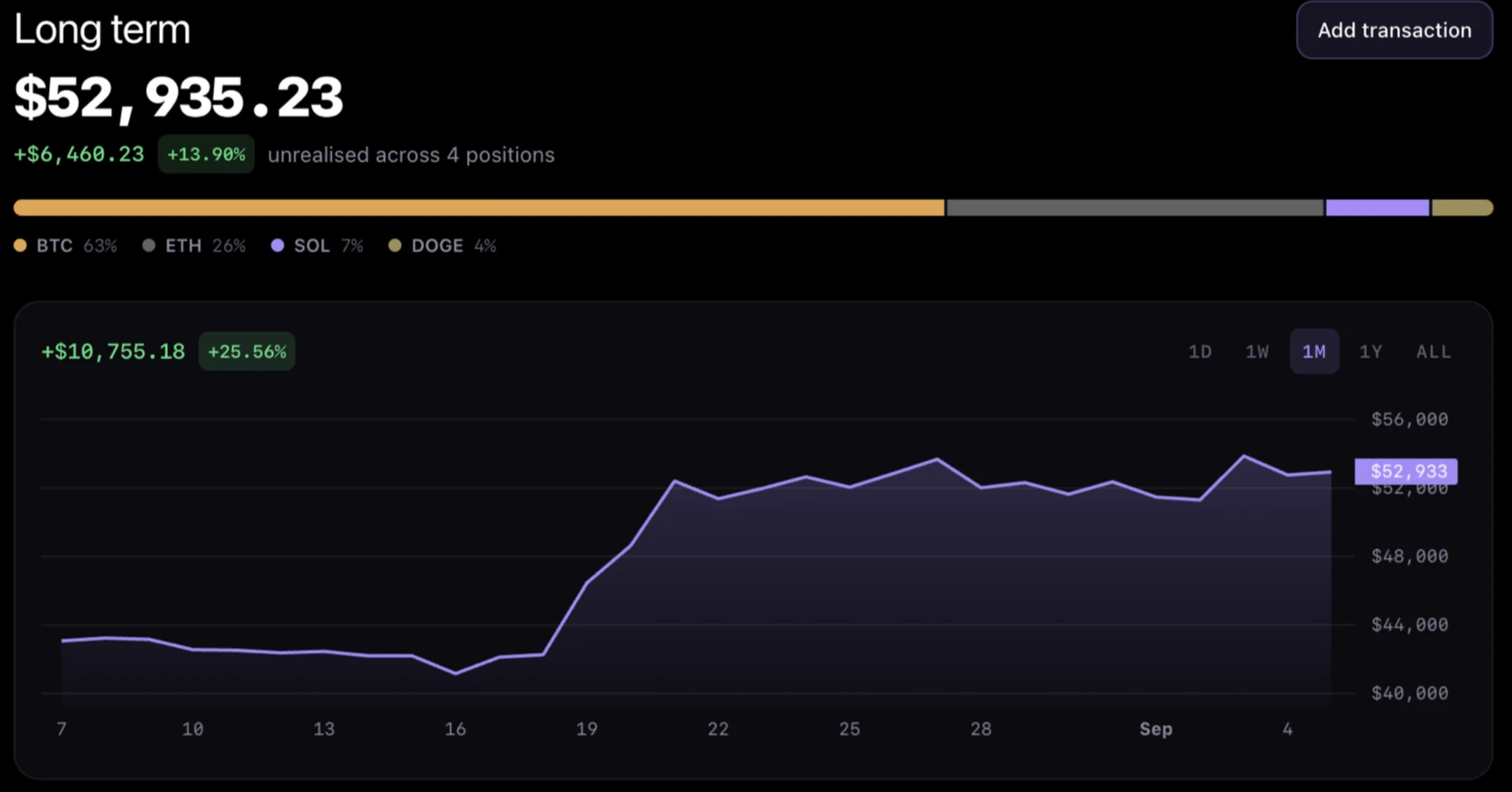
The total is held in Bitcoin, with the fiat equivalents available alongside it rather than replacing it.
What changes when you switch
Denominating in BTC treats Bitcoin as the unit of account. Your holdings are converted to their BTC equivalent using live pairs, and profit is measured against what you would have had holding BTC instead.
The consequences are worth spelling out:
- A pure BTC position is flat. If everything you own is Bitcoin, your BTC denominated total does not move regardless of price. That is correct: you have the same number of coins.
- Altcoin gains become relative. A coin that doubled in dollars while BTC also doubled shows no BTC gain. It kept pace, nothing more.
- Stablecoins now fluctuate. Held in dollars, a stablecoin balance is flat. Priced in BTC it rises when BTC falls, and falls when BTC rises.
None of this is a different calculation applied to the same question. It is a different question.
When the dollar view is the right one
BTC denomination is not automatically better. Use fiat when:
- You are tracking against a real world goal, a deposit, a purchase, retirement
- You need figures that correspond to what you would actually receive on selling
- You are working toward a tax filing, which is denominated in your local currency
Use BTC when you are judging whether your trading and altcoin picks beat simply holding Bitcoin. That is a hard benchmark and most portfolios fail it, which is exactly why it is a useful one.
Switching denomination
The currency belongs to the portfolio. Change it and every total, every coin's value and every profit figure updates. Your transactions do not change, only the unit they are shown in. Keep two portfolios in two currencies if you want both answers at once.
Conversion uses live pairs from the exchanges you follow, so a coin's BTC value is derived from real market prices rather than a static rate.
Available denominations
Alongside Bitcoin and Ethereum, totals can be shown in: US dollar, euro, pound sterling, Japanese yen, Canadian dollar, Swiss franc, Argentine peso, Brazilian real, Indonesian rupiah, Nigerian naira, Polish złoty, Romanian leu, Russian rouble, Turkish lira, Ukrainian hryvnia and South African rand.
The full list of feeds these are derived from is in supported exchanges.
A note on the comparison
Denominating in BTC is the crypto version of asking whether an active fund beat the index. It is unflattering, and that is the point. If a year of picking altcoins left you with less Bitcoin than you started with, no dollar figure changes that, and it is better to see it than not.
