
Almost every crypto portfolio tracker asks for the same thing during setup: an API key from your exchange. It is presented as a convenience, and it is one. It is also the single largest piece of information you can give away about your finances.
Moonitor does not ask for one. This page explains what that changes, and what it costs you.
What an API key actually hands over
A read only exchange API key is usually described as safe because it cannot withdraw funds. Withdrawal is not the only thing worth protecting.
A read only key typically exposes:
- Every balance in the account
- Full trade history, including prices and timestamps
- Deposit and withdrawal history, which often links to your bank or to on chain addresses
Handed to a tracker, that data goes to the tracker's servers, because the sync has to run whether or not your laptop is open. It is stored there. It is backed up there. It is covered by whatever that company's security is, and by whatever their privacy policy allows them to do commercially.
The risk is not that a key lets someone steal your coins. It is that a complete, timestamped record of your financial position now exists on a server you do not control, tied to your email address.
Exchange breaches and tracker breaches are both routine. The 2020 Ledger leak was a customer database, not a wallet compromise, and it still produced years of targeted phishing and physical threats against people whose holdings were now a matter of public record.
How a tracker works without keys
Prices and holdings are two separate problems, and only one of them needs your account.
Prices are public. The price of BTC/USDT on Binance is the same for everyone. Fetching it needs no authentication, and Moonitor reads these public feeds directly from the 16 exchanges it supports.
Holdings are private. So you type them in. When you buy 0.5 ETH at $2,400, you record that in the app. The entry is written to a local database on your machine.
Multiply the two and you have a portfolio, with no credential anywhere in the chain.
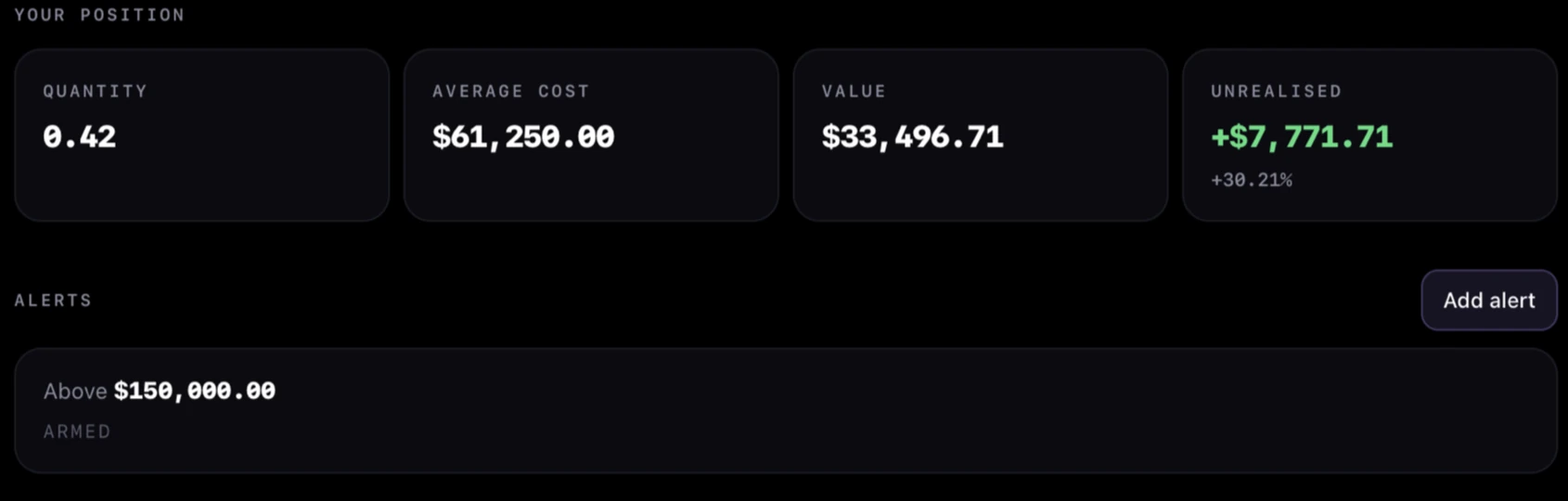
The line at the bottom is a purchase entered by hand. That is the only way holdings get into the app, and it is why no exchange credential is needed.
What is stored, and where
Everything Moonitor knows about you sits in a database file on your own device. On desktop that is local application storage; on iPhone it is the app's private container.
There is no account to create, no email to verify, no sync service, and no analytics SDK. The app makes exactly one kind of outbound request: public price data from exchanges. If you disconnect from the internet, the app still opens and your holdings are still there, just with stale prices.
This also means the responsibility is yours. There is no "forgot password" and no server side copy. If you wipe the device without a backup, the portfolio is gone.
The honest trade off
Manual entry is real work, and it is the price of this design.
It suits you if you buy occasionally and hold, keep a handful of positions, or simply do not want your balances in someone else's database. Updating after a purchase takes a few seconds.
It does not suit you if you trade frequently, run bots, or hold positions across a dozen venues you need reconciled automatically. Manual entry at that volume is miserable, and a tracker with API sync is the better tool. We would rather tell you that than have you buy the wrong thing.
There is a second limitation worth stating: because Moonitor only knows what you tell it, it cannot detect an airdrop, a staking reward, or a token you forgot about. It shows the portfolio you describe, not the one the blockchain knows about.
No key, no surface
The security argument for this design is narrow but solid. A credential that does not exist cannot be leaked, phished, misconfigured, or left behind on an exchange account you stopped using years ago. There is no key to rotate and no permission scope to get wrong.
That is the whole pitch. Everything else about Moonitor, the charts and the profit tracking and the multiple portfolios, is ordinary portfolio software. The part that is unusual is what it declines to ask for.
Next steps
- How to track your crypto portfolio on desktop is the practical setup guide
- Supported exchanges lists the price feeds available
- Moonitor for iPhone uses the same local only design
- Private and open source crypto portfolio trackers compares the other trackers that keep your data local
- CoinStats and Delta comparisons, if you are moving from a tracker that syncs through the cloud
